
Making Sense of Sorting
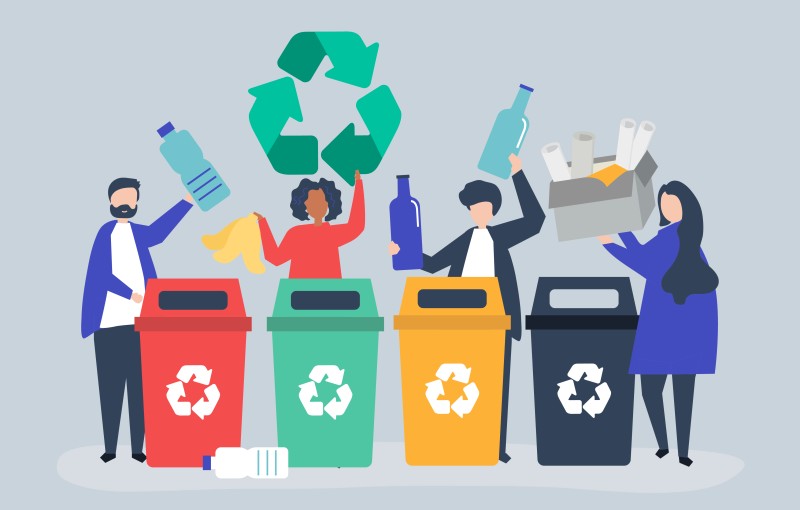
Can the municipality of Copenhagen apply learnings from behavioral science to increase households’ degree of waste recycling in order to become a CO2-neutral city by 2025?
Since 2012, the municipality of Copenhagen has invested heavily in making it possible for its citizens to sort their waste into the most common fractions such as bio, plastic, paper, metal etc. The result has been that around 45% of household waste is sorted which roughly means that less than half of all households actively participate in waste sorting even though doing so has been made as easy as ever.
As a result, the municipality has realized that for the degree of waste sorting to increase, citizens need to be further motivated to engage in waste sorting and hereby better utilize the provided infrastructure. Since monetary incentives appealing to extrinsic motivation might be troublesome to introduce in a setting where each households’ waste production is not directly visible (as many people live in apartment buildings and dump their waste at certain stations), it is necessary to appeal to other motivators.
We therefore chose to conduct an experiment where we exposed two yards of apartment buildings to a set of interventions meant to make individuals aware of a social norm to sort waste while seeking to invoke warm glow and promote other-regarding preferences. This was done by handing out postcards to all households with information regarding the societal benefits associated with waste sorting while attaching normative feedback stickers to all waste containers in the yards comparing the households’ waste sorting effort to that of the city district.
Following 11 weeks of measurements we could conclude that our intervention had significant treatment effects leading to an increase in the level of bio waste in the treated yards in three to four weeks out of six, depending on the applied econometric model. Thus, the treated households appeared to have been positively affected by the normative feedback and the provided information.
These insights not only showcase that behavioral science can have a significant impact on individuals’ sorting behavior, they can also inform the municipality’s strategy on how to reach a high degree of waste sorting and achieve CO2-neutrality.
Read the full report here: MakingSenseOfSorting
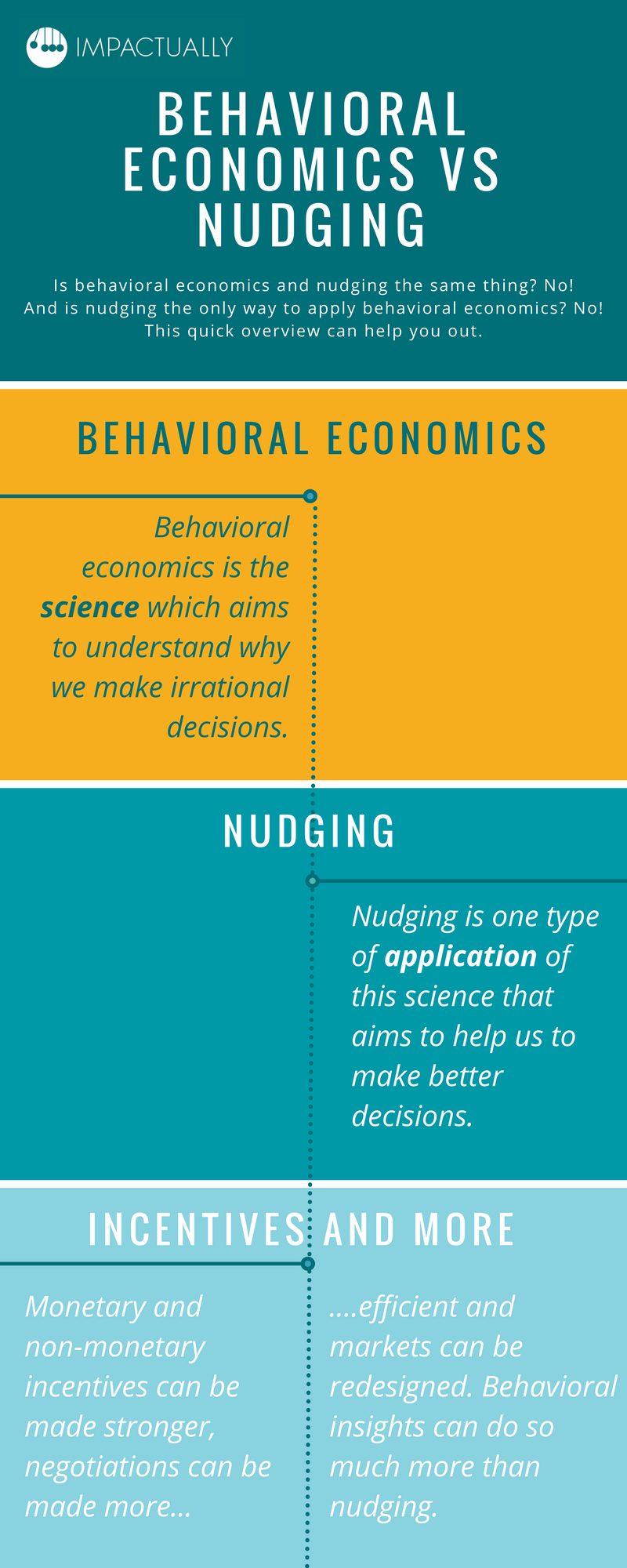
Want to hear us talk more about behavioral economics and nudging? Check out our online course “Designing Nudges”.
You can also download our free and easy-to-use Introductory Guide, which introduces the foundations of the field for people who want to work with behavioral science and nudging in practice.
—

Christina Gravert
christina.gravert@impactually.se
+45 50 17 43 32
I want to learn more!
We hear you. If you’ve already read our post about what behavioral economics is, and how it can be used in practice, then here’s a list of books, TED Talks and other online resources. Other interviews, articles and videos we have published elsewhere can be found here. You are also welcome to sign up to our newsletter, where we give you relevant news and links on behavioral economics.
I’m convinced that behavioral economics can do wonders for me. Now what?
Contact us and let’s talk about how we can help you get going.

We are a management consultancy applying behavioral insights to create business and societal impact. We use our expertise in behavioral economics and social psychology to design evidence-based solutions to critical challenges. We leverage scientific methods to identify interventions that will have long lasting, measurable effects.
DISCLAIMER
FOLLOW US
CONTACT
Email: info@impactually.se
Org. no.: 559167-0327
Web Design: Sharp Studio
Copyright Impactually 2024